Every piece of clothing has a small tag with tiny symbols on it. Most people ignore them. But those symbols tell you the safest way to wash, dry, iron and bleach your clothes. Getting them wrong can shrink your favourite shirt or fade your best jeans. This guide breaks down all the key laundry symbols so you never have to guess again. Once you learn them, caring for your clothes gets much easier.
What Are Laundry Care Labels and Why Do They Matter?
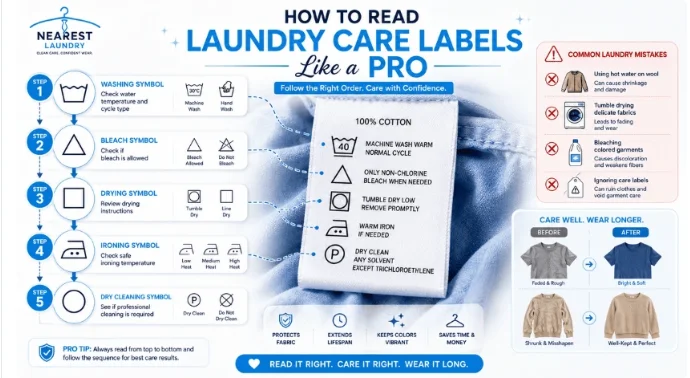
Care labels are small tags sewn into your clothes. You'll find them on the inside seam, collar or waistband. Each label has a set of symbols that tell you how to clean the item safely. These symbols follow a global standard, so they look the same no matter where you buy your clothes.
Why should you care? Because following these labels keeps your clothes in good shape for much longer. Washing a wool jumper on high heat can shrink it in one go. Tumble drying a silk blouse can ruin it for good. When you read the label first, you avoid these costly mistakes. It also saves you time because you won't have to fix damage later. If you want more tips on keeping your clothes in top shape, check our guide on ways to make clothes last longer.
Washing Symbols You Need to Know
The washing symbol is the one you'll see the most. It looks like a small tub of water. The lines and numbers inside it tell you the right way to wash that item.
A plain tub means you can machine wash the item on a normal cycle. No special care is needed.
A tub with a number like 30, 40 or 60 tells you the highest water temperature to use. The number is in degrees Celsius.
A tub with a hand inside it means hand wash only. Don't put this item in the machine.
A tub with one line under it means gentle cycle. Use a slower spin and less force.
A tub with two lines under it means very gentle cycle. This is for the most delicate fabrics.
A tub with a cross over it means do not wash. This item needs dry cleaning instead.
If you're not sure how to wash your clothes the right way, start by reading these symbols every time. It takes just a few seconds and can save your garment.
Drying Symbols and What They Mean
Drying symbols tell you if you can use a tumble dryer and at what heat. The symbol is a square. A circle inside the square means tumble drying is allowed. Dots inside the circle tell you the heat level.
Many clothes get ruined in the dryer, not the wash. High heat can shrink cotton, melt synthetic fibres and crack printed designs. When in doubt, always go with a lower heat or air dry.
A square with a curved line at the top means line dry. A square with a straight line in the middle means dry flat. You'll see the flat dry symbol on knitwear and heavy items that can stretch if hung up.
Symbol | Meaning |
|---|---|
Square with circle and one dot | Tumble dry on low heat |
Square with circle and two dots | Tumble dry on medium heat |
Square with circle and three dots | Tumble dry on high heat |
Square with crossed circle | Do not tumble dry |
Square with curved line at top | Line dry or hang to dry |
Square with horizontal line | Dry flat on a surface |
Square with three vertical lines | Drip dry without wringing |
Ironing Symbols Explained Step by Step
The ironing symbol is easy to spot. It looks like an old-fashioned iron. The dots inside tell you how hot you can set your iron. More dots mean more heat.
One dot means iron on low heat, around 110 degrees Celsius. Use this for silk, acetate and nylon.
Two dots mean iron on medium heat, around 150 degrees Celsius. This works for polyester and wool.
Three dots mean iron on high heat, around 200 degrees Celsius. Cotton and linen can handle this.
An iron with a cross over it means do not iron this item at all. Heat will damage the fabric.
An iron with lines coming from the bottom and a cross over the lines means no steam. You can still press but don't use the steam setting.
A plain iron with no dots means you can iron at any safe temperature. Check the fabric type to decide.
If you see steam lines without a cross, steam ironing is fine. This helps remove deep wrinkles fast.
Getting the heat wrong can burn or melt your clothes. Always start on a lower setting and go up if needed. You can read more about the right way to iron your clothes on our blog.
Bleaching and Dry Cleaning Symbols
Bleaching symbols use a triangle shape. This tells you if you can use bleach on the fabric and what type is safe. Dry cleaning symbols use a circle. The letters inside the circle guide the dry cleaner on what solvents to use.
Most people don't bleach at home very often. But it's still good to know what the symbols mean. Using the wrong bleach can turn white clothes yellow or eat through coloured fabrics. If you see a crossed-out triangle, skip the bleach completely.
Dry cleaning is best for suits, coats and delicate clothes that can't handle water. The circle symbol tells you the item needs professional cleaning. If you're not sure what dry cleaning is or how it works, we have a full guide on that too.
Symbol | Meaning |
|---|---|
Empty triangle | Any bleach is safe to use |
Triangle with diagonal lines | Only non-chlorine bleach allowed |
Crossed-out triangle | Do not bleach this item |
Plain circle | Professional dry clean only |
Circle with letter P | Dry clean with any solvent except tetrachloroethylene |
Circle with letter F | Dry clean with petroleum solvent only |
Crossed-out circle | Do not dry clean this item |
How Do You Read Laundry Care Labels on Clothes?
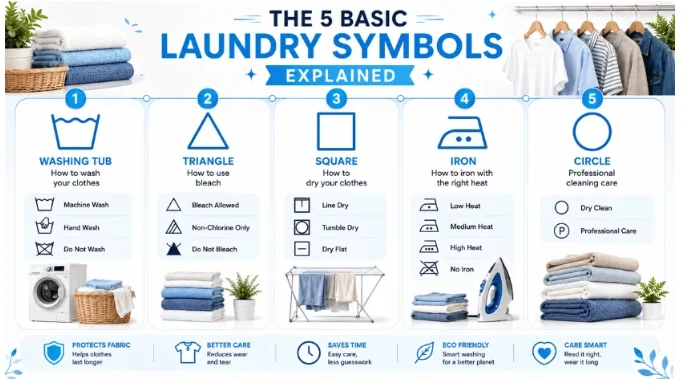
Read care labels from left to right. Each symbol covers one step of the cleaning process. They follow a set order of wash, bleach, dry, iron and then dry clean. Once you know the five basic shapes, you can read any label in the world.
The five shapes are a tub for washing, a triangle for bleaching, a square for drying, an iron for ironing, and a circle for dry cleaning. Numbers, dots and lines inside these shapes add extra detail. A cross over any symbol means "do not" do that step. Most labels have three to five symbols on them. If your label has faded and you can't read it, play it safe. Wash on a gentle cold cycle and air dry. That's the lowest-risk option for most fabrics.
How Nearest Laundry Takes Care of Your Clothes
We know that not everyone has time to check every label and sort every load. That's where we come in. At Nearest Laundry, we read every care label on every garment. Our team sorts your clothes by fabric, colour and care needs before washing. We use the right temperature, the right cycle and the right products every time.
Need dry cleaning or ironing? We handle that too. We pick up your clothes for free and drop them back clean and fresh. No more guessing what symbols mean or worrying about ruined clothes. Follow us on Instagram and LinkedIn for daily laundry tips and deals.
Conclusion
Laundry symbols are not as hard as they look. Five basic shapes cover everything you need to know. A tub for wash, triangle for bleach, square for dry, iron for press, and circle for dry clean. Dots, lines and numbers inside these shapes give you the details. A cross means stop.
Take a quick look at the label before you wash anything. It takes just a few seconds and can save your clothes from damage. If you'd rather leave it to the pros, book your order with Nearest Laundry today. We follow every care label so your clothes come back fresh and safe every time.